
NB: Original post in Swedish here.
Perhaps the awakening comes when you, as a customer in home care or other elderly care, start thinking about your rights, the quality of the services, and the proportions between the help you receive and what you pay.
What have you given to Sweden during your long life?
And what do you get back?As background – read my column (in Swedish) about what I call “home-no-service” here.
Links to all my columns on elderly care can be found here.
Conditions and rights in elderly care are not the same for everyone, if you thought they were. Certain groups have rights and benefits that differ from – and in many cases are far more favorable than – the conditions and rights you have as an ordinary native Swede.
The most common serious violent crime against women over 60 is rape
The intense debate that is now underway about elderly care – at least on social media – has rather belatedly gotten started since Anders Östlund, criminologist in Police Region Central, presented a study of rapes in elderly care.
The most common serious violent crime against women over 60 is rape – something that greatly surprised Anders Östlund. Women in their 80s to 100s are subjected to sexual violence in their own homes by male home care employees.

Anders Östlund’s surprise is an interesting measure of the obliviousness that has for far too long characterized the view of the enormous differences in culture and view of humanity, compared to Swedish counterparts, which have become frighteningly clear with the mass immigration of primarily young men from dysfunctional Muslim countries in the Middle East and Africa.
In 2015, around 36 000 so-called “unaccompanied children” arrived in Sweden – in reality men of military age who had thrown away their ID documents and lied about their age. It is largely these men whom we now allow to care for our oldest and most fragile citizens.

To those of you reading my blog and learning things you never hear in mainstream media:
If you appreciate my journalism and my podcasts, please feel free to support me with a donation.
Swish number: 123 519 92 86
Bankgiro: 111-9072
Warm thanks for your support!
Invited to a table set with female flesh
Here, one-eyed and blind politicians and officials have generously invited groups of culturally deviant men to help themselves from a table set with female flesh. In the name of integration and employment, decision-makers have proceeded from the naive notion that all people are equal and that men from Somalia and Afghanistan function exactly like Swedish men.
The result is a catastrophe, a nightmare of horror and insecurity that 80–100-year-old women are forced to live with day and night during the last part of their lives.
Many express that what is happening is so unbelievably terrible that they do not want to believe it is true. But unfortunately it is true.

Almost 400 rapes of women over 60 have been reported to the police from 2021 to today, i.e. on average around one hundred per year. The perpetrators are often unknown to the victims, and according to Anders Östlund, the suspect was in all cases employed in home care.
“The dark figure is gigantic”
“I am very surprised by the figures” says Anders Östlund to Upsala Nya Tidning and adds: “The dark figure is gigantic.”
His investigation shows black on white a reality in which society’s weakest – women aged 80–100, with fragile health and in many cases dementia – are extremely vulnerable to foreign men who have been quota-placed in elderly care with the help of the Swedish Public Employment Service, urged on by lobby organizations SKR (Swedish Association of Local Authorities and Regions), the Confederation of Swedish Enterprise, and politicians’ ardent desire to conceal the extent of the unemployment they have imported without consequence analyses from dysfunctional developing countries in the third world: Syria, Afghanistan, Irak, Somalia, Eritrea and others.
In an attempt to conceal, among other things, the sky-high unemployment resulting from the headless parliamentary decision on the “Afghan amnesty” in 2018, special state-subsidized employment forms have been created, for example Introduction Jobs and New Start Jobs. State-subsidized jobs for hard-to-place people far from the labor market.

“Elderly women an uninteresting group”
Mainstream media, with the exception of Upsala Nya Tidning and occasional targeted efforts in Expressen, have had no idea about the rapes of elderly women and are not interested at all in anything as uninteresting as elderly women and elderly care. The subject is treated as plague-ridden.
No one, NO ONE, can defend frail, elderly women being raped by men who are paid to help them. Therefore, the safest thing is to silence the subject to death.
“They are seen as an uninteresting group. Every time an elderly person is affected, one can get the impression that it is about a single tragic event. But when statistics are compiled like this for once, you get a completely different picture” says Anders Östlund in UNT.
Alternative media are also slow and usually lack knowledge of social issues and elderly issues. The same lax attitude exists among most politicians.
Politicians and journalists are crossing their fingers hoping that public anger does not escalate
I obviously cannot prove it, but I suspect that significant parts of the political class and their loyal lackeys, the journalists, are crossing their fingers tightly hoping that public anger simmers on low heat and does not escalate to a level where rapes in elderly care become an election issue. Enormous resources and radical new thinking are required to rescue elderly care from its nightmare scenario, and the issue is intimately linked to a devaluing view of old people.

If you follow the issue closely, it is obvious that it has grown in importance after UNT’s articles in 2024–2025 about 84-year-old Elsa in Uppsala, who was raped – despite having previously alerted the home care company about an employed man who had sexually molested her.
The government proposes measures – but only scratches the surface
After the latest home care rapes, the government now proposes measures, for example the right for employers to request extracts from the criminal record when hiring staff in certain areas, including elderly care and work with children. But there is no right for employers to demand checks from the criminal record on already employed staff.
Yet it is more likely that people who have committed sexual offenses are found among already employed staff than among newly arrived people who have gotten their first job in elderly care. The latter have simply been employed for such a short time that in most cases they have not had time to commit serious sexual offenses.
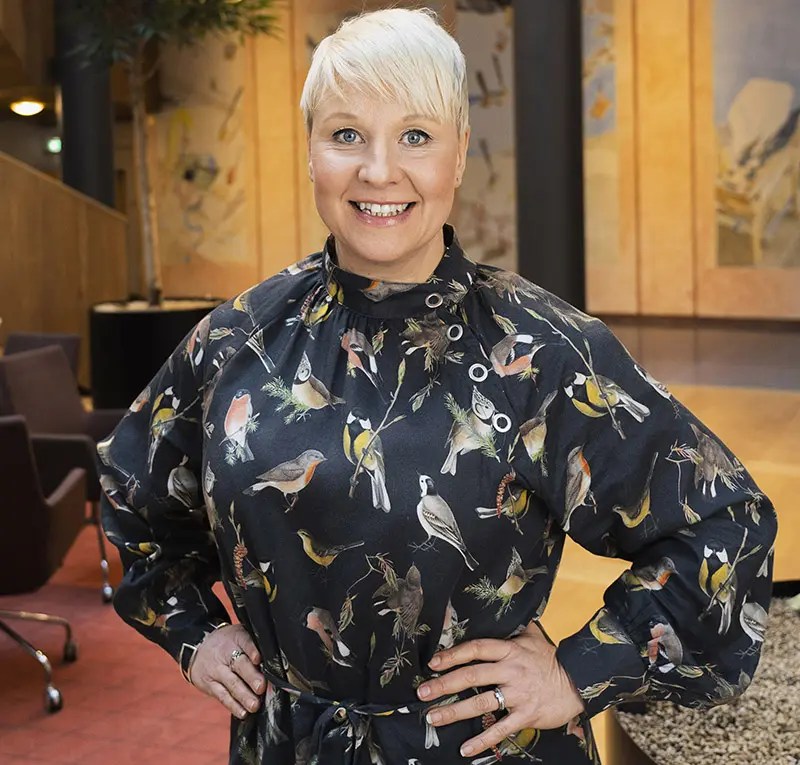
Minister for the Elderly and Social Security Anna Tenje (M) has made statements about the situation where most rapes occur, namely when men from distant cultures are to shower and handle intimate hygiene for elderly women. Then the temptation becomes too great and irresistible for many with a skewed view of women.
Anna Tenje wants elderly care customers to have the right to choose the gender of the person performing such tasks. It is a completely obvious position. She shares the same view as most Swedes. Elderly women should not have to be subjected to having their intimate hygiene handled by a man.

The news that Iraqi Shakir Mahmoud Shakir raped a 100-year-old woman stirred up such a public outcry that something had to be done. But note that the public outrage and reaction did not come until that rape was reported. It was not enough with 89-year-old or 94-year-old rape victims. A 100-year-old had to be affected before the news became sufficiently outrageous and something happened.

Unfortunately, it is not enough for a minister to express an opinion supported by public opinion. Elderly care is managed by municipalities and regions, and for opinions to be translated into practical action, municipal politicians and elderly care officials – often women – need to turn them into action.

Women in managerial positions in elderly care are not necessarily in solidarity with the care recipients/customers. They have, as it were, a gap or a large hole where empathy should be, a defense mechanism against the realization that they themselves will grow old and need help.
I strongly doubt that any of the female managers in elderly care want their private parts washed by a Baasim or Ali Hassan, who see women as defenseless prey that are easy to overpower.
More a punch in the air than well-thought-out parts of a package of measures
Anna Tenje’s proposed measures are unfortunately just pieces torn out of context, and more to be regarded as surface scratching or desperate punches in the air than as well-thought-out parts of an effective package of measures.
For politicians, the decisive question is whether they should work reactively (let the damage happen and frail elderly women be affected again and again before they act) or proactively (prevent by banning men in home care and making the profession a female profession again).
Yes, all men. If only men from risk groups are excluded from working with women, we will certainly get stuck like glue in racism discussions. Men can work with many other things.
The entire organization needs to be smashed – and rebuilt from the beginning
The entire home care organization needs to be smashed, all ingrained preconceptions slaughtered, and then everything rebuilt from the bottom up. No political party in parliament has so far shown sufficient courage, knowledge, and strength to implement a real systemic change in elderly care.
How much longer shall we pretend that all people are equal?
A central question of values and view of humanity
Ultimately, the shortcomings in elderly care boil down to a central question, that of values and view of humanity. What value do we ascribe to those who have worked and contributed to our country for 50–60 years or more, but who are now old and need help?
Everyone has the right to basic assistance under the Social Services Act. But do they have the right to receive help from people who speak Swedish? No. What about the right of native Swedes to be treated in accordance with their culture, language, values, and traditions that have developed in our country over generations? In short, to be treated as the people they are?
I am thinking of the third paragraph of the Act:3
§ Act:3 The social services shall be directed towards enabling individuals to live a life of dignity and experience well-being.
Is it a dignified life and a right to well-being to be worn down as an elderly person by constant worry and fear of being raped in one’s own home or in a nursing home? Obviously not! The treatment of elderly people in their own right is literally a matter of life and death for those who have little time left to live and when every day is precious.
What rights do the elderly have in Sweden?
With the help of AI Grok, I have amused myself by investigating what rights and benefits different population groups have in elderly care in Sweden. I proceed from the assumption that the different rights reflect the value we attach to each respective population group.
Special rules for Muslims
Muslims do not have the status of a national minority and therefore have no specific rights beyond freedom of religion, which applies to everyone. But unsurprisingly, Muslims are in a class of their own when it comes to demands for treatment and considerations based on Islam.
In 2017, the Shia Muslim organization shiasamfund.se issued a brochure titled “Your Muslim Patient”. The brochure contains “information for you who care for patients with Islamic faith” and lists a long series of demands and rules that staff in various care settings are expected to follow.
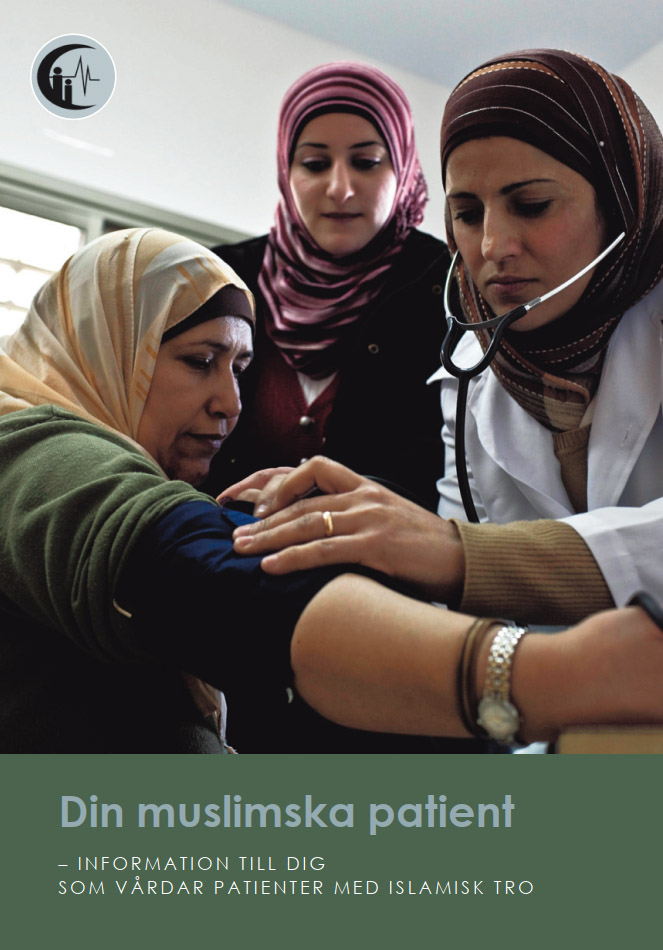
The number of Muslims in Sweden at that time (2017) was perceived to be between 500,000 and 600,000 people.
“We should be aware of the similarities and differences in how religion is practiced, in order to meet these patients with understanding and openness” the preface to the brochure emphasizes.
The brochure was produced by a Muslim working group linked to the then state-funded Islamic Cooperation Council (ISR) and edited by Smajo Sahat, hospital imam in Skövde. The Swedish Agency for Support to Faith Communities (SST) handled the further distribution of state grants— that is, the disbursement of tax money — until January 1, 2025. Now that has come to an end.
This followed alarms from Säpo. The reason is that representatives have acted in ways that counteract democracy. SST ceased to exist as an independent agency on January 1, 2026, and has been transferred to MUCF (the Swedish Agency for Youth and Civil Society).
The brochure “Your Muslim Patient” lists a range of adaptations that Muslim patients believe they have the right to expect in various care situations, including in healthcare. While Swedish women must fight hard — if they or their relatives have the energy — and are often denied help with hygiene from a female employee, it is a self-evident right for Muslims to receive help from a person of the same sex.
No home care manager would ever think of sending a man to a Muslim woman
At the same time as large numbers of Muslim men are sent daily into Swedish women’s bedrooms and bathrooms, no home care manager would ever think of sending a man to a Muslim woman.
Some points from the brochure:
- Opportunity to perform the five daily prayers – even in a hospital.
For Muslim women, it is important to be able to wear traditional clothing, such as a headscarf, to the greatest possible extent.
Patients who cannot speak Swedish should have access to an interpreter.
Fridays are Muslims’ central day of worship. Many Muslim patients therefore want their treatment rescheduled to another day of the week.
Muslims want to be examined by a doctor of the same sex. This also applies to nurses.
Many do not want to expose their private body parts (between the navel and knees) – except when absolutely necessary.
Even during childbirth and surgery, many wish to be covered with a sheet so that he/she does not have to feel embarrassed.
Muslims must pray five times a day. Access to a clean space for prayer should be available, with prayer mats. Opportunity to face Mecca (qibla). Each prayer usually takes up to 15 minutes. During the prayer itself, it is important for a Muslim not to be interrupted or disturbed.
Pork and blood food are forbidden as food for Muslims. Meat must be halal-slaughtered.
The main rule for Muslims is to refrain from medicines containing substances that are forbidden according to Islam, such as alcohol or substances derived from pigs. There is insulin that does not come from pigs, and it is important that a Muslim diabetic receives the “right” type of insulin.
In Muslim tradition, it is prescribed to visit the sick around the clock, participate in care, handle the patient’s intimate hygiene, and so on. This creates collisions with healthcare visiting hours and staff’s need to perform their work undisturbed.
Muslims do not accept gender mixing in any form. Today, all hospital wards in Sweden – except women’s clinics – are mixed wards, and sometimes men and women are mixed in the same room. This is a major problem for both Muslims and non-Muslims. Municipalities can sometimes voluntarily adapt to Muslim demands, for example by offering halal food in nursing homes if there is demand, or taking account of holidays (such as Eid). But it is not a right and there is no legal requirement – it depends on the municipality’s policy, resources, and staff.
There are no formal rules for special rights for Muslims. Instead, the rule is: “The one who feels most offended and shouts the loudest gets their way.”
The Persikan nursing home for Persian-speakers
For Iranians and other Persian-speakers as well as Arabs, there is specialized elderly care at the Persikan/Bejtona nursing home, a language-profiled nursing home in Akalla in northwest Stockholm “aimed at you with roots in the Middle East. Here you can rest in your own language and eat food you are used to.”
The languages are Persian and Arabic, Azari, and Kurdish.
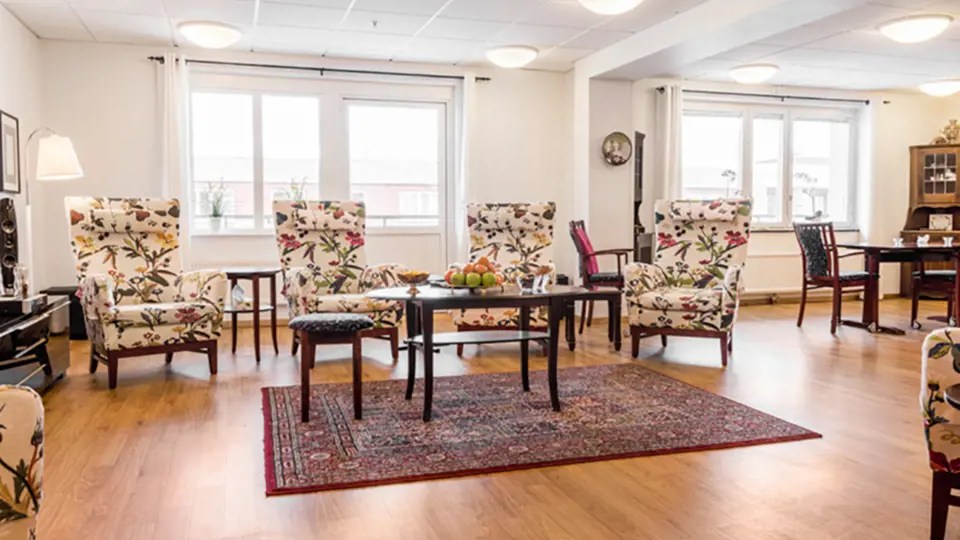
“Your apartment can be furnished with furniture from your previous home” promises Persikan.
Everyone working in direct care has care training, masters both Persian and Swedish, and is service-oriented. There are staff who speak Azari and Kurdish. Kavat Vård has its own chefs in the house who cook Persian food.
In the common living room there is a large TV with Persian-language programs. Persikan observes both Swedish and Persian traditions and holidays. Anyone who wants to can go out into the fresh air every day.
In Midsommarkransen, Stockholm, Kavat Vård runs the La Casa nursing home, with a Latin American atmosphere, for Spanish-speaking residents.
The Jewish Home follows Jewish traditions
Jews (who are a national minority) have the right to elderly care, wholly or to a substantial extent in Yiddish if staff who master the language are available. Jewish-profiled nursing homes exist in both Stockholm and Göteborg, both characterized by Jewish customs and traditions, kosher food, and a cultural environment.
“We strictly adhere to Jewish traditions at the Jewish Home; the food served is kosher and consideration is given to Jewish traditions in end-of-life care as well as at death.”
Neuberghska Bambergerska nursing home in Göteborg:
“Great focus has been placed on the artistic decoration of the building and on creating a cozy and beautiful environment. The building was designed by Jan Izikowitz, who also designed the Göteborg Opera, and in the large dining room there is one of the largest stained-glass windows created in modern times in Sweden.
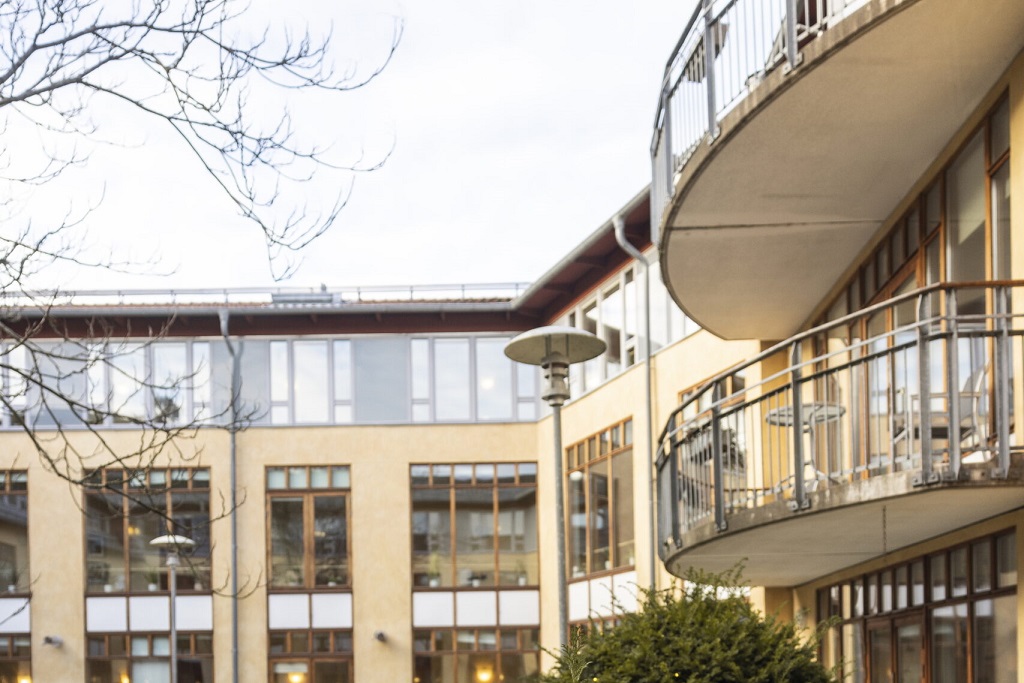
”The home is situated high up with a beautiful view, and we have a lovely courtyard where we spend time often, and a large assembly hall for sports and cultural activities.”
In Sweden, we have five national minorities established by law (2009:724 on national minorities and minority languages): Sami, Jews, Roma, Sweden Finns, and Tornedalians. Their rights do not automatically apply to other groups, regardless of religion, country of origin, or immigrant background – including Muslims (who most often come from countries outside the EU) or Iranians.
The Sami are the most strongly protected
Sami have the right to elderly care, wholly or to a substantial extent in Sami, if they live in an administrative area for Sami. This applies particularly to the municipalities included in the administrative area, for example Arjeplog, Gällivare, Jokkmokk, Kiruna, but also extended to more municipalities such as Dorotea, Storuman, Strömsund – a total of around 25 municipalities nowadays.

There is no statutory right to Sami food everywhere, but in practice several municipalities in Sami areas (for example Berg municipality) regularly offer Sami food – often once a week at homes or home delivery to Sami who wish it.
There are also no legal requirements for separate “Sami homes” throughout the country, but several municipalities have established Sami-profiled or niche elderly homes to better meet the cultural needs of the Sami, for example in Umeå, Åsarna and Bergvattengården’s Skogsforsen unit with Sami-profiled elderly care in Dorotea, Jokkmokk, Gällivare, among others. These homes often celebrate Sami holidays, use Sami culture in activities, and offer food with a Sami character.
Despite criticism that too little is invested in Sami culture, the Sami are the most strongly protected group with the right to Sami-speaking staff, Sami-profiled homes, Sami food, and so on.
Roma, Sweden Finns, and Tornedalians, as national minorities, have similar language and cultural considerations in elderly care (for example Romani chib, Finnish, Meänkieli), but in practice it varies more than for the Sami.
Native Swedes have no such statutory special requirements
For native Swedes (the majority population) there are no such statutory special requirements regarding language, culture, or religion in elderly care. Swedes in many cases receive substandard care from staff who very rarely master the Swedish language, and without any requirement for profiling towards Swedish traditions, Swedish culture (Swedish music, Swedish art and literature), and Swedish history.
Native Swedes are the ones who count the least.
How did it become this way?
Without us and our culture, there would be no Sweden.
 Julia Caesar