
Read the original post in Swedish here!
This morning I heard it from my terrace. The unmistakable ko-ko call from somewhere in the distance. It was unusually early and sounded unusually close.
After a long flight from Africa, the cuckoo is back on our Nordic latitudes once again, letting its characteristic two-note call be heard — a sound that many of us enjoy hearing because it is so strongly associated with the arrival of spring.
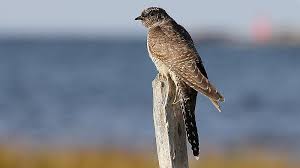
The cuckoo builds no nests of its own and does not care for its offspring; instead, it parasitizes other, smaller birds. The truth behind the cuckoo’s alluring call is a brutal story of occupation of others’ homes, false identity, mass murder, ethnic cleansing and coldly pitting group against group.
As tradition dictates, in May I am republishing my chronicle “The Cuckoo’s Lost Moral Foundation.”
If you appreciate my journalism and my podcasts, feel free to support me with a gift.
Swish number: 123 519 92 86
Bankgiro 111-9072
Warm thanks for your donation!
The chronicle about the cuckoo is the most “racist” one I have ever written — at least according to Dagens Nyheter’s editor-in-chief Peter Wolodarski.
Read the text as a reminder of the completely insane debate climate that dominated 10–11 years ago!

When I was subjected to unannounced home visits, public shaming, media storms, and character assassination in 2015, I filed a complaint against Dagens Nyheter and Expressen with the Press Ombudsman. In his statement to the PO, Peter Wolodarski wrote:
“One of the most racist chronicles in Caesar’s production is ‘The Cuckoo’s Lost Moral Foundation.’ At first glance it appears to be about birds, more specifically the cuckoo. Ornithological facts about the cuckoo are lined up. But the chronicle must be read in its context, as part of Caesar’s campaign against immigration.”
What Peter Wolodarski does not know is that ornithology has been one of my great interests since childhood. Not a single word about humans appears in my cuckoo chronicle. Yet Wolodarski still manages to present it as “part of Caesar’s campaign against immigration.” It is an outstanding example of paranoia that must be unique of its kind. One can draw no other conclusion than that the cuckoo — without being aware of it itself — is a terribly racist bird.
Read my chronicle and judge for yourself!
The Cuckoo’s Lost Moral Foundation
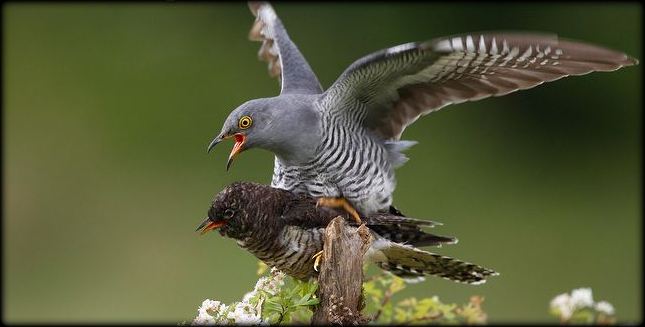
Photo from ARKive of the Cuckoo (Cuculus canorus) – http://www.arkive.org/cuckoo/cuculus-canorus/image-A23114.html
Driven solely by self-interest, it stages one of the world’s most skillful and brutal deceptions. Ruthlessly, it exploits and parasitizes others that are smaller and weaker than itself. To achieve its goal, it forges its identity, coldly occupies others’ homes, and quickly turns them into bases for mass murder and ethnic cleansing.
You hear it for the first time on one of those lovely spring days in early May. We let ourselves be seduced by the mysterious sound that resembles nothing else. Two tones, always in the distance, as if elusive and impossible to locate. A magical sound, intimately associated with the Nordic early summer. In reality, it is the prelude to a deadly drama. The male’s two notes are not intended to delight us. The sound is a territorial marking to other males to stay away and the starting signal for a brutal tragedy.
There was a time when the cuckoo’s ancestors built their own nests and cared for their own offspring. But that was several million years ago. Something happened that caused the cuckoo to abandon its moral foundation, relinquish all responsibility, and begin a career as an empathy-disordered parasite and deceiver. The career choice has proven highly profitable — the cuckoo gets a lot for nothing, while those who are exploited are robbed of everything they have.

Both Miloš Forman’s hit film *One Flew Over the Cuckoo’s Nest* from 1975 and Ken Kesey’s novel of the same name are based on an illusion. Cuckoos build no nests. Homeless and asocial, they roam around and parasitize birds that are smaller and weaker than themselves. The story of the cuckoo is a shocking tale of conscienceless predation, crude deceptions, cold infiltration and scruple-free egoism.
But it takes two to tango. The story of the cuckoo is also a story of allowing oneself to be deceived, of naïve blue-eyed gullibility and good faith unto death. Without the astonishing lack of defensive instincts in the birds that allow themselves to be exploited, the cuckoo would be forced to change its behavior and start taking responsibility for its own children and housing situation.
That change has not yet occurred, and nowadays the cuckoo lives in total absence of any moral foundation. It completely disregards the equal value of all birds and consistently makes itself guilty of incitement against bird groups. It cares nothing at all for its own offspring. In the bird world, there is no morality and no feelings of guilt. The cuckoo’s criminal lifestyle is accepted by nature, which knows only one law: kill or be killed. Eat or be eaten.
When the cuckoo arrives in the Nordic region and raises its mythical ko-ko in early May, it does not come to enjoy the beautiful nature or to provide us with acoustic pleasure. The reasons are crasser than that. On the one hand, the Nordic countries offer sustenance through free access to food; on the other, they provide the perfect setting for staging the mass murder that is the cuckoo’s specialty.
In accordance with the free movement within the EU, the cuckoo is spread across all of Europe and is found in almost all biotopes, except Iceland, which is not an EU member. It tolerates almost all climates and has been present at our latitudes for at least 4,000 years, from the later part of the Stone Age. Humans have long understood that the cuckoo carries death and misfortune under its wings. In old Swedish folklore, it is surrounded by magical notions that largely concern sorrow and death:
Södergök är dödergök. (Southern cuckoo brings death).
Norrgök är sorggök. (Northern cuckoo brings grief).
Västergök är bästergök. (Western cuckoo is a best cuckoo.)
Östergök är tröstergök. (Eastern cuckoo brings comfort.)
It is right now in May that the cuckoo’s promiscuous lifestyle, to the tones of the males’ ko-ko, breaks out in the spring landscape on a scale that would make even RFSU [the Swedish Association for Sexuality Education] blush. The cuckoo is old-fashioned heterosexual but distinctly polyamorous. Copulation is vigorous in the forest, and both males and females mate wildly with several different partners during the same season.
The cuckoo’s gender roles are distinctly sex-specific. Equality is an unknown concept. In accordance with feminist ideals, the females hold all the power. The male’s role is reduced to sperm provider — as often as he feels like it, to be sure — but his workload must still be described as light.
Perhaps it is the degrading gender power structure or the fact that he is underemployed and bored that makes him seem to lack all interest and talent for romantic courtship. If he really wants to make an effort, he can scrape together a bit of grass or larvae in his beak and give it to the female right before the act itself. There is rarely more fuss than that. It’s wham-bam, no frills.
Once the male has completed his sperm deliveries, he has done his part for the season and can pass the time sitting in a treetop ko-koing all day long. Eventually he doesn’t even do that.
The female has considerably greater goals in sight. It is she who must carry the lineage forward. There are no signs that she experiences the mission as less prestigious — on the contrary, she spares no means to succeed. She flies around in her several-square-kilometer egg-laying territory and intently scans for suitable small-bird nests to encroach upon. For at least a month, she lays one egg every other day. If she finds enough nests to freeload on, she can lay up to 20–25 eggs in a season, all in different nests.
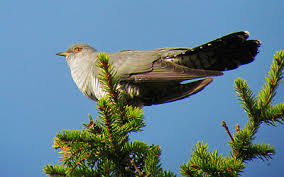
With its blue-gray or brown plumage and aggressively cross-barred belly, the cuckoo looks like a bird of prey. And it is one, even if it is not counted among the raptors. It most closely resembles a male sparrowhawk. The cuckoo rules through fear; its appearance is designed to scare away small birds so that the female cuckoo can undisturbed occupy and plunder their nests.
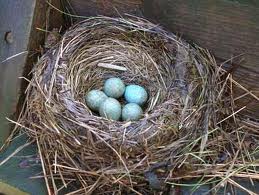
Cuckoo eggs have been found in more than 150 bird species. The cuckoo prefers to parasitize on poor creatures that lack the sense to defend themselves: wagtails, reed warblers, garden warblers, lesser whitethroats, meadow pipits, and redstarts. Pied flycatchers, swallows, and magpies are also possible victims.
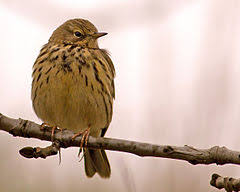
In northern Sweden, yellow wagtails, bluethroats, bramblings, Lapland buntings, and meadow pipits are most exposed to the cuckoo. The meadow pipit in particular can be heavily affected, with up to one in ten nests taken over by the cuckoo. In Norway, the whinchat is the most common victim.
To succeed with its devilish plan, the female cuckoo sits for hours on her lookout post keeping watch over the targeted nest. When she has assured herself that the small birds are out flying and the nest is empty, she strikes. The attack is lightning-fast. In just a few seconds, she dives into the nest, swallows one of the small birds’ eggs, and lays one of her own.
She chooses the timing carefully. She knows that birds are most attentive and alert in the mornings. Therefore, she lays her egg late in the afternoon or early in the evening. When the nest owners return to the nest, they notice nothing of the intruder’s visit. For small birds, it has proven not to matter if the nest contains one egg too many. Birds cannot count.
The female cuckoo’s secret is that every egg she lays in other birds’ nests is a masterful forgery. By imitating the prospective foster parents’ own eggs, she prevents them from becoming suspicious and gets them to care for her chick without complaint. The female cuckoo usually parasitizes the same bird species her whole life. Therefore, she “knows” exactly what kind of eggs to produce.
The cuckoo makes a clear distinction between “us” and “them” and engages in systematic discrimination entirely without guilt. The female is extremely selective when choosing which nests to lay her eggs in. It must be a gullible species that will care for the cuckoo chick as if it were their own, without protest.
The foster parents, on the other hand, make no distinction between “us” and “them,” and this will, as we shall see, end in catastrophe. With their boundless and self-sacrificing goodness, they create their own tragedy. When summer draws to a close, they have been deprived of their own offspring, and if they do not sharpen their vigilance, there is an imminent risk that they will suffer the same bitter fate again and again.
Most bird species that the cuckoo parasitizes lay 4–5 eggs and incubate them for about two weeks. The cuckoo egg, however, hatches after only twelve days. This guarantees that the newly hatched cuckoo chick is first on the scene in the occupied nest.
Scarcely has the chick cracked the eggshell before it loudly begins begging for food. During all the daylight hours of the day, the poor foster parents toil hard, flying shuttle traffic and catching insects to stuff into the greedy chick’s maw.
They would of course have fed their own chicks if they had had any — the difference is that the cuckoo chick has secured a monopoly position and alone gulps down as much food as an entire brood of small birds. Newly hatched and naked, it is so pitifully ugly that only thoroughly deceived foster parents can feel compelled to care for it. They have little inkling of the cuckoo chick’s plans.
As soon as the egg has hatched, the cuckoo chick begins its mass murder and ethnic cleansing. The occupied nest is small, adapted to the small birds’ own needs and those of their children for space. For the cuckoo chick, it becomes cramped, and it feels offended by the competition for space from the foster parents’ own eggs.
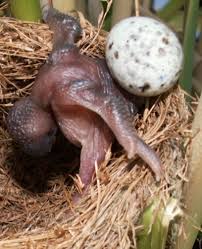
Deliberately, it puts its bestial plan into action. Already during its first days of life, it shoves all the eggs out over the edge of the nest, one by one, until it is the sole master of the roost. If any of the foster parents’ eggs have happened to hatch, the newly hatched chick has no chance. The cuckoo chick pushes it out of the nest to certain death.
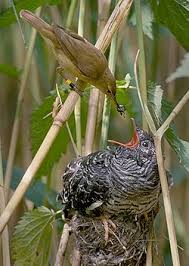
The foster parents are completely unprepared and defenseless against the cuckoo chick’s violent behavior. In pictures (see literature reference), one can see, among others, marsh warblers and dunnocks seemingly completely indifferent while the cuckoo chick is in full swing taking the lives of their children.
Strangely enough, they never lift a feather to defend their own offspring. Instead, they suppress their defensive instincts and enter an almost apathetic state. Paralyzed, they observe the mass murder of their chicks and accept that only one chick remains — and it is not even their own. When the ethnic cleansing is complete, they have lost their entire brood.
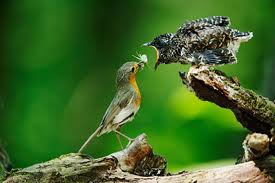
Incomprehensibly, the foster parents continue to feed their children’s murderer. Here culminates a self-destructiveness on the level of a suicide cult. The phenomenon can only be explained by reality denial, cluelessness, and total inability to draw relevant conclusions.
Because the cuckoo chick eats 5–8 times as much as each of the foster parents’ own chicks would have, it grows at record speed and soon becomes grotesquely large. But even when the cuckoo chick is many times larger than the foster parents, they do not realize they have been thoroughly deceived.
Now the chick deploys its next survival weapon: its hideous begging call. It is such a powerful and insistent sound that it corresponds to the volume of 4–5 of the foster parents’ own chicks — a fire alarm or the call to prayer from a minaret.
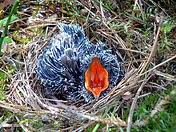
The alarm from the cuckoo chick and its constantly gaping yellow-red maw not only drives the foster parents to nearly tear the life out of themselves to get enough food. The signals are so strong that even other birds can be stressed into stopping feeding their own chicks and instead starting to feed the cuckoo chick.
On one occasion, ornithologists have seen a cuckoo chick being fed by two redstarts, a meadow pipit, and a dunnock — in addition to the foster parents, a pair of wagtails. Whole groups can thus feel compelled to show solidarity and take responsibility for the insatiable parasite.
The foster parents continue to feed the cuckoo chick throughout the summer, long after it has grown out of and left the nest. Here a real dilemma arises. The large cuckoo chick increasingly begins to resemble an adult cuckoo.
Most small birds detest cuckoos and mob them whenever they get the chance. Perhaps they carry collective memories of millennia of oppression. In any case, it clearly goes against small birds’ moral foundation to feed an adult cuckoo.
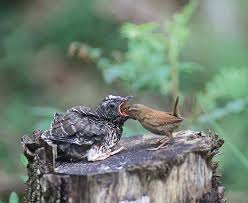
A big cuckoo chick is fed by a much smaller bird.
To avoid triggering the foster parents’ cuckoo-mobbing instinct, the cuckoo chick conceals its identity by sitting motionless and trying to look like any bird chick whatsoever. Every flap of the wings, every flight movement risks revealing its true identity. And the foster parents swallow the deception hook, line, and sinker.

An evolutionary arms race is underway between the cuckoo’s ability to imitate other species’ eggs and the small birds’ ability to identify a foreign and unwanted egg. The better the small birds become at detecting deviant eggs, the more finely the female cuckoo adjusts the appearance of her eggs. After many millions of years, the score stands 1–0 to the female cuckoo. But the small birds are arming themselves for revenge.
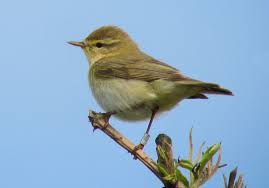
The winners so far are chaffinches and willow warblers, Sweden’s most common birds. They are the only ones who take on the cuckoo.
They have developed heightened vigilance — a kind of xenophobia if you will — that allows them to recognize cuckoo eggs. In this way, they manage to resist the cuckoo’s attacks and save the lives of their own chicks.
Most birds do not notice that the cuckoo egg is slightly larger than their own eggs, but for chaffinches and willow warblers, size matters. As soon as they suspect that one of the eggs in the nest is too large to be their own, they abandon the nest.
This protective instinct is probably a consequence of having been exposed to the cuckoo’s violence for a very long time. Chaffinches and willow warblers do not forget. The traumatic outrages seem to remain especially in the tiny (9-gram) willow warbler’s memory. As soon as it spots a cuckoo, it becomes extremely aggressive.
As for the dunnock, we can let hope go, at least for the time being. A special tragedy hangs over the dunnock. It is so stupid that it has no protective behavior at all against the cuckoo. It practically begs to be deceived. It lays blue eggs itself, but the appearance of the cuckoo egg seems to play no role. Perhaps the cuckoo has only recently begun parasitizing dunnocks, so it has not yet had time to acquire an effective defense. But it will, even if it may take thousands of generations. As soon as the cuckoo begins parasitizing a species, the arms race begins through evolution’s natural selection.
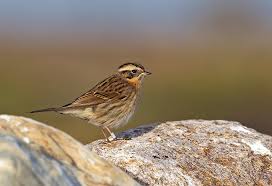
When the cuckoo chick is a couple of months old, it realizes that it is a cuckoo and seeks out others within the same ethnic group. It is a difficult period of identity-seeking and losses when the young cuckoos are thrown into life’s hard school and must manage on their own without being coddled by self-effacing foster parents.
The biological parents already bug out at the end of summer to their homeland in Africa, south of the Sahara. There awaits nine months of vacation in a warm climate after the summer’s strenuous parasitic existence. No one knows how it works, but the young cuckoos find their way to the homeland themselves, without help from the parents or other older cuckoos. This suggests that the migration instinct and flight route are inherited, i.e., genetically conditioned.
What is the meaning of the cuckoo’s asocial and violence-endorsing life?
How can evolution reward a mass murderer?
The idea that life must have a meaning is a misunderstanding. It is an intellectually constructed human perspective. At the human level, one can at best give life a meaning, but that is another matter.
Evolution’s only meaning is development, and it operates with the time perspective of infinity. There is a constant arms race between different species that maintains a kind of balance of terror in the development of life forms and living spaces vis-à-vis other species.
Is there any hope of redress for the majority of the small-bird population that constitutes the cuckoo’s victims? Certain signs suggest that a change may be underway.
Nowadays the cuckoo is declining in numbers in southern Sweden and in Finland, and the decline has occurred in just a few decades. It may be because some of the species the cuckoo parasitizes have developed their protective behaviors and become better at exposing the deceiver. Another example is the marsh warbler, which is very attentive to the difference between its own eggs and the cuckoo’s.
The hope naturally lies in more and more seeing through the cuckoo’s manipulation and rebelling against the oppression. Seeing through the opponent’s motives is the beginning of liberation. When affected small birds realize the seriousness and begin to defend themselves, the resistance can spread quickly.
Literature:
Per G. P. Ericson and Hans Sjögren: Boken om göken (The Book about the Cuckoo).

